More than whether today's air is bad, most DC readers want to know how anyone actually arrives at that number in the first place. The figure on your phone can feel like magic, but it's the end product of monitors, a federal formula, and a chain of agencies most residents never think about.
Once you see how the air quality Washington DC number gets built, you'll better understand how it helps you make smarter decisions about outdoor activities, while also reminding you to pay attention to the air you're breathing at home.
TL;DR Quick Answers
air quality washington dc
DC's air quality comes from six DOEE monitoring stations feeding EPA's national 0-500 AQI scale. Ozone drives summer spikes (May–September) while fine particles (PM2.5) dominate the rest of the year, especially during wildfire smoke season. Once the AQI clears 100, sensitive groups should limit outdoor time. Past 150, that guidance applies to everyone, making high quality air filters an important way to help maintain cleaner indoor air when outdoor pollution levels increase.
Top Takeaways
DC's AQI comes from a national EPA formula applied to readings from six local monitoring stations.
Ozone and fine particulate matter are the two pollutants that drive most of the District's daily readings.
The District's basin geography and regional pollution drift make DC's ozone problem worse than local traffic alone would explain.
Readings can vary block to block, not just day to day, so a good number at one station doesn't guarantee clean air everywhere.
The AQI only measures outdoor air. What happens once those pollutants reach your home is a separate question entirely.
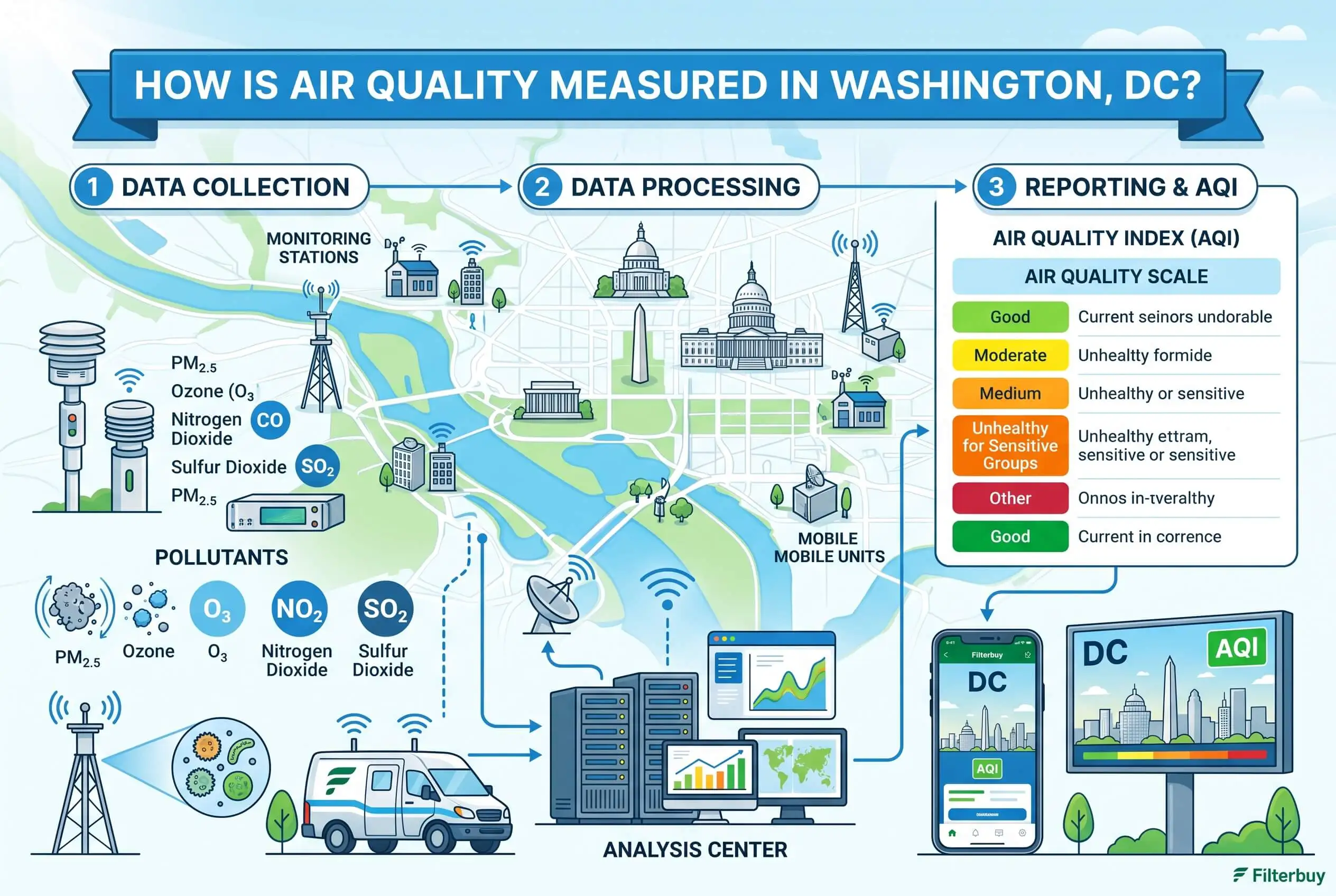
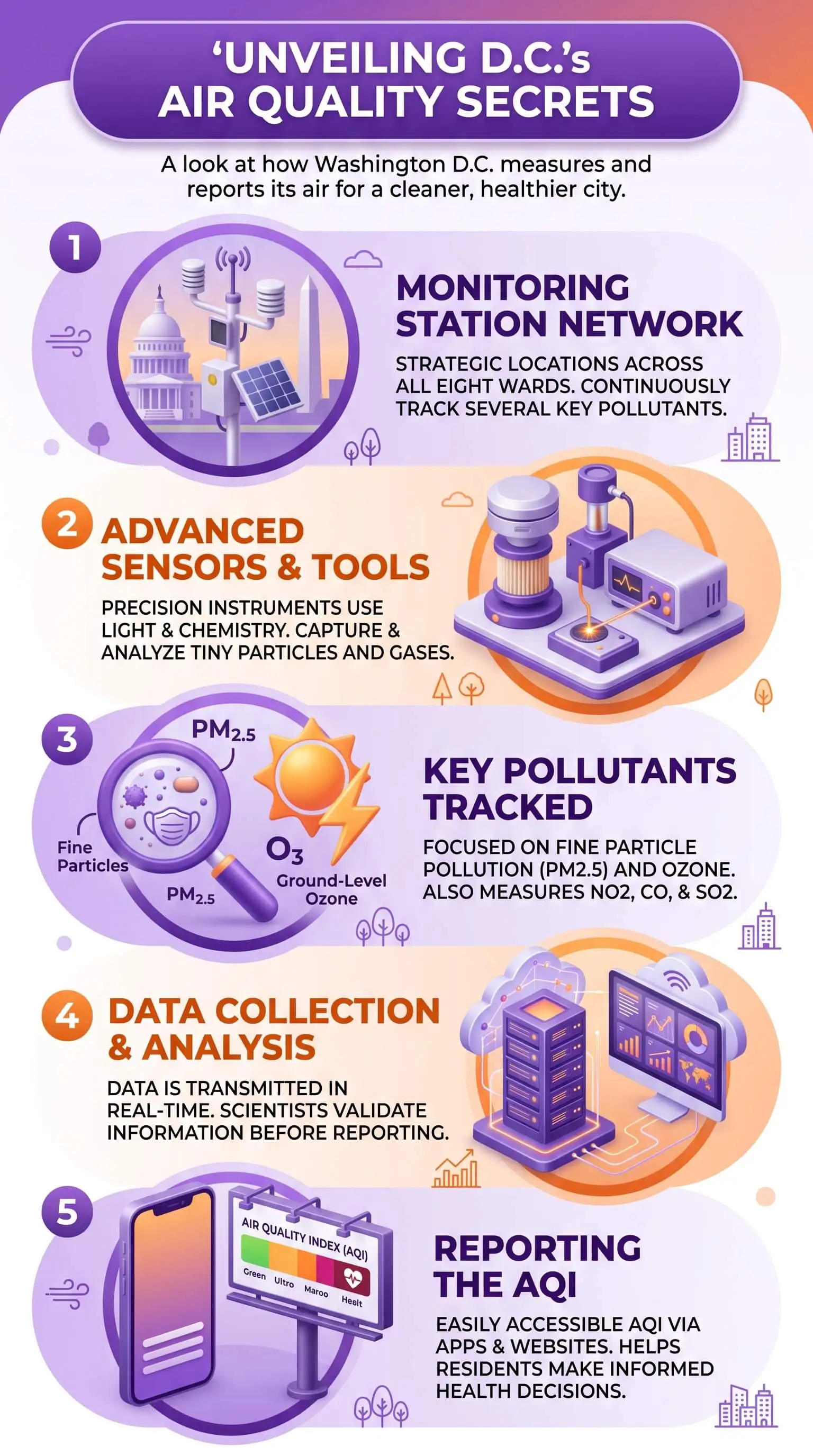
The Environmental Protection Agency built the Air Quality Index in the 1970s and locked in its current form in 1999. It runs on a 0-to-500 scale, built around five pollutants regulated under the Clean Air Act: ground-level ozone, fine and coarse particulate matter, carbon monoxide, sulfur dioxide, and nitrogen dioxide. Each pollutant gets its own sub-index based on measured concentration. Whichever sub-index is highest at that hour wins. That's the number you see.
That raw pollutant data has to come from somewhere physical, and in the District, the Department of Energy and Environment does the job. DOEE runs six around-the-clock monitoring stations at McMillan Reservoir, River Terrace Education Center, Takoma Recreation Center, the Anacostia Freeway near-road site, Bald Eagle Recreation Center, and King Greenleaf Recreation Center. Staff visit these sites regularly to calibrate equipment, swap filters, and confirm the readings meet federal quality standards before that data ever reaches the public. For homeowners, pairing these outdoor readings with practical indoor steps, such as learning how to get rid of pet dander, can help support cleaner air inside the home.
Geography does DC no favors here. The city sits low in a basin, hemmed in by the Blue Ridge to the west and the coastal plain to the east, and that bowl traps heat and stagnant air on summer afternoons, letting ground-level ozone build fast. Add pollution drifting in from Virginia, Maryland, and the Ohio Valley, and a single city's AQI reading suddenly depends on plenty it can't control. Ozone spikes hardest between May and September. Fine particulate matter runs as a year-round concern instead, with sharp jumps during wildfire smoke season and winter wood-burning. This holds across the whole Washington, D.C. metro area too, not only the blocks nearest a monitor.
Once DOEE's monitors capture that raw data, it moves up the chain to EPA for national reporting and to the Metropolitan Washington Council of Governments for regional forecasting shared across DC, Maryland, and Virginia. The number on your phone has already passed through several sets of hands and a fair amount of atmospheric science by the time you glance at it on your way out the door.
“In my years covering home and air-quality topics, the DC households that understand what actually feeds that AQI number are the ones who act before a bad-air day arrives, not after.”
7 Essential Resources
1. AQI Basics: Where the National Formula Actually Lives
AirNow is EPA's own explainer for how the 0-to-500 scale works, including the six color-coded categories and the five pollutants that feed the formula. This is the source page if you want the math behind the dial, not just the dial itself.
Source: www.airnow.gov/aqi/aqi-basics/
2. The District's Own Monitoring Network
DOEE operates six 24-hour stations across the District, sited by population density, traffic patterns, and pollution history. This page lists the exact locations and explains how often staff calibrate and service the equipment.
Source: doee.dc.gov/service/ambient-air-quality-monitoring
3. DC's Report Card on Ozone and Particle Pollution
The American Lung Association's State of the Air grades every county in the country on three years of monitoring data. The District's page shows exactly how DC scored and why, broken down by pollutants.
Source: www.lung.org/research/sota/city-rankings/states/district-of-columbia/district-of-columbia
4. Free Regional Alerts Before the Air Turns Unhealthy
Clean Air Partners has issued Code Orange and Code Red alerts for the Washington-Baltimore region for more than 25 years. Sign up for the free app or email alerts here instead of manually checking the AQI every morning.
Source: www.cleanairpartners.net/air-quality-resources
5. The Six Pollutants the Law Requires EPA to Regulate
The Clean Air Act requires EPA to set national standards for six criteria pollutants. This page breaks down each one, why it's regulated, and how the standards get reviewed and updated over time.
Source: www.epa.gov/criteria-air-pollutants
6. Where Air Quality Data Meets Public Health Data
CDC's National Environmental Public Health Tracking Network links air monitoring data to health outcomes like asthma and cardiovascular disease at the county level, useful context beyond the raw AQI number.
Source: ephtracking.cdc.gov/
7. Who's Actually Behind the Number You See
AirNow itself is a partnership among EPA, NOAA, the National Park Service, NASA, CDC, and state and local air agencies. This federal overview lays out who does what and covers more than 500 U.S. cities.
Source: www.drought.gov/data-maps-tools/airnow-air-quality-index-monitoring-and-forecasts
These trusted resources explain how Washington, DC's air quality is monitored, forecast, and linked to public health, while regular HVAC maintenance can help improve the indoor air you breathe when outdoor pollution levels change.
3 Statistics
Regional Ozone Days Are Down 78 Percent Since 1997
The Metropolitan Washington Council of Governments' latest trends analysis found unhealthy ozone days across the region dropped roughly 78 percent between 1997 and 2023, even though ground-level ozone is still the one pollutant that hasn't met the federal standard.
Source: www.mwcog.org/file.aspx?A=MGVJK3AZsBoPJKWjLJR2svWroJCrIcQj7Ea+qP0lv84%3D
Smoke Events Push Half or More of Outdoor Particles Indoors
Lawrence Berkeley National Laboratory's research on wildfire smoke found that indoor PM2.5 concentrations typically rise to somewhere between 49 percent and 76 percent of outdoor levels during a smoke event, depending on the home's construction and ventilation.
Source: iaqscience.lbl.gov/wildfires
A Satellite Now Watches DC's Air Down to Four Square Miles
NASA's TEMPO instrument has monitored North American air pollution hourly during daylight since 2023, with resolution down to roughly four square miles, about the size of the National Mall, giving scientists a far more detailed view of pollution over the DC-Philadelphia-New York corridor than ground stations alone.
Source: www.nasa.gov/news-release/nasa-shares-first-images-from-us-pollution-monitoring-instrument/
With regional ozone days declining, wildfire smoke still affecting indoor air, and satellite monitoring providing more detailed pollution data, air quality testing is a valuable way to understand the air you breathe both outdoors and inside your home.
Final Thoughts and Opinion
Most people treat the AQI number the way they treat a weather app icon: a glance, then a shrug. That's a mistake. Air quality differs from weather in one big way. You can't stop ozone from forming over a hot DC afternoon, but you can control what happens to that air once it reaches your own front door.
Understanding the mechanics behind the number does more than satisfy curiosity. It changes how you react to it. A Code Orange day means something different once you know it's built from six real monitoring stations and a federal formula, not just a color someone picked. It's also a good reminder to check your pleated furnace filters, since cleaner indoor air becomes even more important when outdoor pollution levels rise.
 Frequently Asked Questions
How is the AQI calculated?
EPA measures concentrations of five major pollutants, converts each into a sub-index on a 0-to-500 scale, and reports whichever sub-index is highest at that hour as the overall AQI.
What agency measures air quality in Washington, DC?
The DC Department of Energy and Environment operates the District's physical monitoring network, and that data feeds into EPA's national AQI reporting system.
What is considered a healthy AQI number?
EPA rates an AQI of 50 or below as good. Above 100, sensitive groups should start limiting outdoor activity, and above 150, that guidance applies to everyone.
Why does DC's air quality vary by neighborhood?
Pollution sources aren't evenly distributed. Traffic corridors and industrial areas can run measurably worse than a monitoring station just a mile or two away, which is why block-level data matters. Along with proper roofing, these local conditions can also influence how much outdoor pollution makes its way into your home.
Does the AQI tell me anything about the air inside my home?
No. The AQI measures outdoor air only. Indoor air quality depends on separate factors like ventilation, filtration, and how well-sealed your home is. Using a MERV 8 pleated HVAC air filter can also help improve indoor air by capturing many common airborne particles that the outdoor AQI does not measure.
CTA
Check today's live AQI reading for the District and see exactly where it lands on the scale above, then make sure your air filters are clean to help maintain healthier indoor air.