Most roof leaks in Santa Barbara start months before anyone sees a drop of water. The damage builds through a dry summer, then shows up as a ceiling stain after the season's first big storm.
You can get ahead of it. Before the rains come, check your roof from the ground and clear your gutters and drains. Fix any damaged flashing and cracked tiles or shingles, look for moisture in the attic, and book a professional inspection in September or October.
From May through September, Santa Barbara gets well under an inch of rain in total. All that sun dries out sealants and wears down underlayment, while sundowner winds work tiles loose. You won't see any of it until water finds a way in, and by then every roofer in town is booked. The best plan for roofing Santa Barbara homes starts in the fall, not in January.
Your roof works as a set of layers, and a heavy rain tests every one of them at once. Tiles or shingles sit on top, with underlayment beneath them. Flashing seals each seam, and gutters and drains carry the water away. We'll walk you through the checklist we'd follow on our own homes, how prep changes by roof type, and the point where a licensed roofer should take over.
This year, start early. In September 2026, Santa Barbara County officials told the Board of Supervisors that seasonal outlooks favor above-normal rain from October through April, and the county has already begun preparing for El Niño storms.
TL;DR Quick Answers
Roofing Santa Barbara
Good roofing in Santa Barbara means a roof built for long dry summers, coastal salt air and short, heavy winter storms, installed by a licensed local contractor who knows the region's clay tile homes. Quality Roofing has done that work here since 1996.
Local track record: Family-owned, women-led and licensed since 1996 (CSLB #504492), with more than 10,000 roofs serviced across Santa Barbara County.
What locals overlook: On older clay tile roofs, the underlayment often fails decades before the tiles do. An inspection should check what's under the tile, not just the tile itself.
Services: Roof repair, replacement, reroofing, inspections, maintenance, fire-rated roofing, emergency leak response and commercial work.
Materials: Clay tile, concrete tile, shingle, flat roofing, slate and synthetic.
Service area: Santa Barbara, Montecito, Hope Ranch, the Riviera, Goleta, Carpinteria, Summerland, Mission Canyon and the Santa Ynez Valley.
How it works: A free on-site estimate with a written, itemized scope, up to a 7-year workmanship warranty on qualifying installs, and a 4.8 out of 5 rating on Google.
Best timing: Book in September or October, before the rainy season fills roofers' calendars.
Contact: Call (805) 965-2416.
Top Takeaways
Timing: Prep your roof in September or October, before Santa Barbara's wet months begin.
Drainage: Clear gutters, downspouts and flat-roof scuppers so water leaves your roof quickly.
Flashing: Check the seals around chimneys, skylights, vents and solar mounts, where many leaks start.
Roof type: Match your prep to your material. Clay tile roofs need an underlayment check more than any other.
Documentation: Take dated photos of your roof to support any future insurance claim.
Professional help: Call a licensed roofer for anything that means walking on tile, working at height or fixing interior stains.
When Does the Rainy Season Start in Santa Barbara?
The rainy season here usually runs from late October or November through March. January is the wettest month. NOAA's 1991–2020 normals for the Santa Barbara Municipal Airport put the yearly average at about 15.7 inches, and roughly 3.9 of those inches fall in January alone.
Those numbers sound mild. The trouble is how the rain arrives. Atmospheric rivers, long plumes of tropical moisture, bring much of it and can drop several inches in a day or two. So a roof that's gone five months without a drop suddenly takes hours of wind-driven rain.
Why Dry Summers Hide Roof Damage
A long dry season wears a roof down without making any noise about it. When we trace a winter leak back to its source, the damage often started the summer before.
Sun and heat: UV exposure dries out the sealant around vents and skylights and turns older underlayment brittle.
Sundowner and Santa Ana winds: Strong downslope gusts lift shingle tabs, crack ridge mortar and shift tiles out of place.
Salt air: Near the coast, salt eats away at metal flashing and fasteners faster.
Debris: Leaves, eucalyptus bark and pine needles pile up in valleys and gutters. Once the rain starts, they act like dams.
Curious what these problems look like up close? Our guide to the most common roof problems walks through each one.
Your Santa Barbara Roof Prep Checklist
Work through this list in September or early October, while it's still dry and roofers still have open dates.
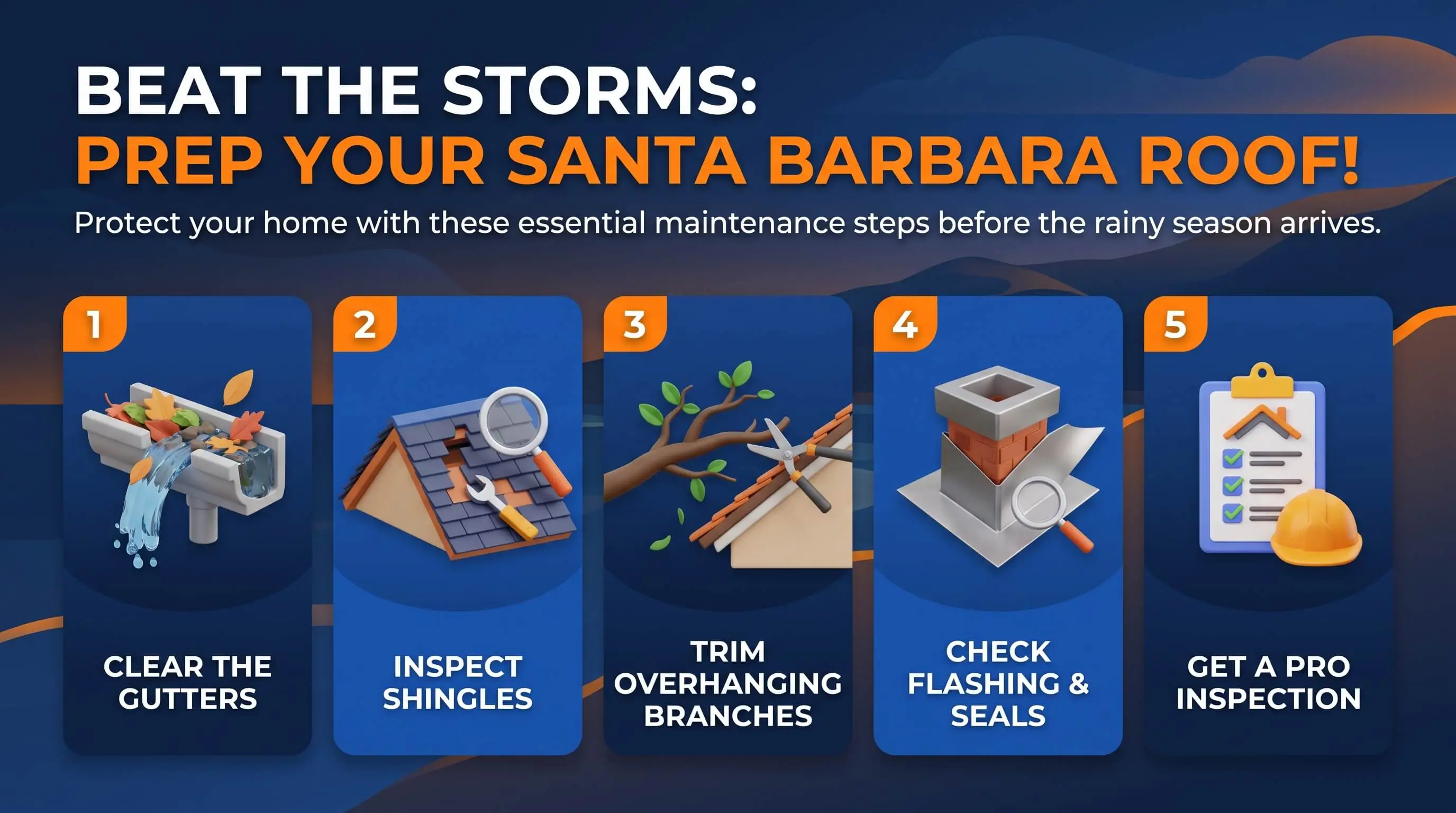
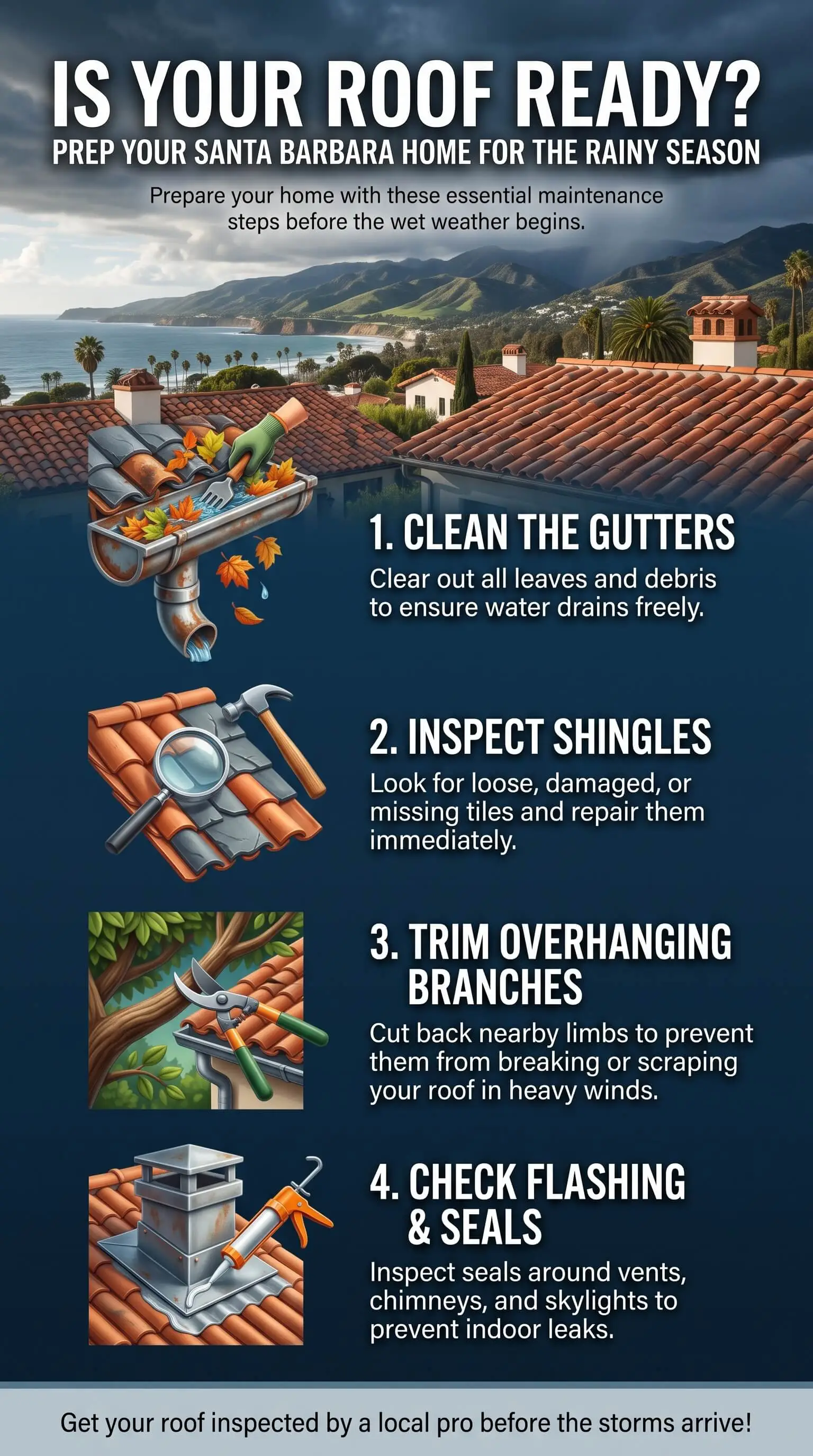
Scan the roof from the ground. Grab binoculars and look for slipped, cracked or missing tiles and shingles. You'll catch a lot without ever touching a ladder.
Clear gutters, downspouts and scuppers. Nothing pushes water under roofing materials and against fascia boards faster than blocked drainage.
Check flashing at every penetration. Look around chimneys, skylights, plumbing vents and solar panel mounts for gaps, lifted edges or rust. Flashing is one of the most common places for a roof to leak.
Replace damaged tiles and shingles. One cracked tile can send water straight onto the underlayment below.
Inspect valleys and ridge caps. Valleys carry more water than any other part of the roof, and ridge mortar often cracks after a hot, windy summer.
Look for ponding marks on flat roofs. Dirt rings or stains show where water sat after the last storm. That's where the membrane is working hardest.
Check the attic. Pick a sunny day. Look for daylight coming through the roof deck, stains on the rafters and insulation that's damp or flattened.
Trim overhanging branches. Limbs scrape the roof in the wind and drop debris into your gutters all season.
Make sure downspouts drain away from the house. Water should exit a few feet from the foundation instead of pooling beside it.
Photograph your roof and date the photos. If you ever file an insurance claim, a dated record of your roof's condition helps.
How to Prep Different Roof Types
Every roofing material breaks down in its own way. Match your prep to the roof over your head.
Clay tile: Underlayment wears out beneath tiles that still look fine, and tiles crack, slip or lose their bird stops. Have a roofer check how old the underlayment is and reset or replace loose tiles.
Concrete tile: Tiles crack and underlayment ages here too. These tiles are heavy and break when you walk on them, so replace the broken ones and stay off the roof yourself.
Asphalt shingle: Wind lifts tabs, strips granules and exposes nails. Reseal the lifted tabs and replace any missing shingles.
Flat or low-slope: Most leaks trace back to clogged scuppers, standing water or split membrane seams. Clear the drains and have the seams and patches inspected.
Slate or synthetic: Watch for cracked or displaced pieces and corroded fasteners. An experienced installer should handle the replacements.
A lot of Santa Barbara's Spanish Colonial Revival homes wear clay tile, and those tiles often outlast the underlayment beneath them by decades. The roof can look perfect from the street while the layer that keeps water out has worn thin. If your tile roof is past 20 years and nobody has checked the underlayment, put that at the top of your list. For typical lifespans by material, see our article on how long a roof lasts.
When Should I Call a Professional for Roofing in Santa Barbara?
Call a professional any time the job means walking on tile, working at height or fixing something you can see from inside the house. Clay and concrete tiles crack underfoot. A fall from a roof edge can cause serious injury.
Bring in a licensed roofer if you notice any of these:
Water stains on ceilings or walls
A sagging roofline or soft spots on the roof deck
Several cracked or slipped tiles in one area
Underlayment that's 20 or more years old
Water sitting on a flat roof for more than a day or two after rain
Before the first storm, book an inspection with a crew experienced in roofing Santa Barbara homes, from clay tile on the Riviera to flat roofs in Goleta. A good inspector checks flashing, underlayment and drainage, not just what shows from the street. Before you sign anything, verify the contractor's license with the Contractors State License Board. And if you want to know what an inspector might recommend, our guide to common roof repairs covers the usual fixes.
Schedule Before the First Storm
Once the first storm hits, roofers' calendars fill up and emergency calls go to the front of the line. Book in September or October. It is also a smart time to schedule other seasonal home improvements, including expert HVAC installation, before demand increases. If your inspection shows you need a reroof, give yourself extra time for permits, especially inside city limits.
What to Do If Your Roof Leaks Mid-Storm
If your roof starts leaking during a storm, focus on protecting the inside of your home and stay off the roof until the weather clears.
Set buckets or bins under the drips and move furniture, electronics and rugs out of the way.
If water is pooling in a bulging ceiling, poke a small hole at the lowest point over a bucket to let it drain.
Take photos of the damage inside and anything you can see outside.
Never climb onto a wet roof. Call a roofer for emergency tarping.
Call your insurance company and report the damage.
Before you file, read why it often pays to call a roofer before your insurance company.
"Every October, we hear from homeowners who are sure their roof is fine because the tiles look perfect. Honestly, that's the roof we worry about most. On Santa Barbara's older Spanish-style homes, clay tile can last for generations, but the underlayment underneath often gives out after 20 to 30 years. We lifted tiles on the Riviera and found felt crumbled in our hands. The tiles shed most of the rain, and the underlayment stops whatever gets past them. When that layer fails, the first sign is usually a stain on the ceiling in January. A pre-season inspection, where we lift a few tiles and check what's underneath, takes an afternoon. If you wait for the first atmospheric river, a simple repair can turn into new drywall, insulation and a ceiling."
7 Essential Resources
County of Santa Barbara Storm Preparation: County Public Works posts real-time rainfall and stream-gauge data here, along with flood readiness guides and storm season tips.
ReadySBC: Sign up here for local storm and evacuation alerts from the county's emergency preparedness team.
CSLB Check a License: Look up any California contractor's license status and complaint history before you hire.
NOAA: Atmospheric Rivers Explained: NOAA explains, in plain language, the storms behind much of California's heaviest rain.
Santa Barbara Average Rainfall by Month: See month-by-month rainfall averages drawn from NOAA's 1991–2020 normals.
Insurance Information Institute: Homeowners Insurance Facts: Find national data on what causes homeowners insurance claims, water damage included.
Santa Barbara County Prepares for a Strong El Niño: Read the county's September 2026 update on how it's preparing for the coming storm season.
3 Statistics
About 83% of Santa Barbara's yearly rain falls from December through March. That's roughly 13 of the city's 15.7 average annual inches, based on NOAA 1991–2020 normals. Nearly all of the year's water shows up in four months, so your roof needs to be ready before December.
Atmospheric rivers deliver about 30% to 50% of the West Coast's annual precipitation, often in just a few storms, according to NOAA. One storm can find every weak spot on your roof at once. Small repairs made early are worth it.
About one in 60 insured homes files a property damage claim for water damage or freezing each year, according to the Insurance Information Institute. Stopping a leak almost always costs less, and disrupts your life less, than repairing the damage it leaves behind.
Final Thoughts and Opinion
In our experience, the roofs that fail in the first big storm are rarely the oldest ones on the block. They're the ones nobody has looked at since spring. Santa Barbara rewards homeowners who plan ahead, because the same sunny months that make this place so easy to love also hide the damage the rain will find.
You don't have to climb onto your roof to make a difference. Clearing gutters, checking the attic, trimming branches and taking dated photos are all safe, inexpensive jobs. Leave tile walking, flashing repairs and underlayment checks to a licensed roofer.
Here's where we land. If you own a clay tile roof, give it your closest attention this fall. Those roofs look indestructible, which is exactly why their underlayment goes unchecked for decades. Smart roofing Santa Barbara homeowners can count on spending one afternoon in September so you're not mopping a ceiling in January. With the county preparing for what could be a wetter-than-normal season, this is the year to get it done early.
Frequently Asked Questions
When does the rainy season start in Santa Barbara?
Santa Barbara's rainy season usually begins in late October or November and runs through March, with the occasional April storm. January tends to be the wettest month, averaging close to 4 inches of rain. Since the first storm can show up early, plan to prepare your roof in September or early October.
How often should I have my roof inspected in Santa Barbara?
Most homeowners should schedule a professional roof inspection at least once a year, ideally in early fall before the rains. Book another one after a major windstorm or heavy rain, or any time you spot a ceiling stain. Older tile roofs and flat roofs get the most out of regular checks.
Can a clay tile roof leak even if the tiles look fine?
Yes. Clay tiles shed most of the water, but the underlayment beneath them keeps your home dry. Tiles can last for many decades, while underlayment often wears out much sooner. So a tile roof can look perfect from the street and still leak once the layer underneath fails.
Should I clean my gutters before the first rain?
Yes. Clogged gutters and downspouts push water back under roofing materials and against fascia boards, which leads to rot and leaks. Leaves, eucalyptus bark and pine needles pile up here over the long dry season, so clearing your gutters before the first storm is one of the most effective steps you can take.
What should I do if my roof starts leaking during a storm?
Move your belongings away from the leak, catch the drips in buckets and photograph the damage. If a ceiling bulges with water, carefully let it drain into a bucket. Stay off a wet roof. Call a roofer for emergency tarping, then call your insurance company to report the damage.
Does homeowners insurance cover roof leaks?
That depends on the cause and on your policy. Insurers often cover sudden damage, like a storm tearing off roofing, but they usually exclude leaks caused by wear, age or poor maintenance. Read your policy before the season starts, and keep dated photos and repair records that show you've cared for your roof.
Get Your Roof Ready While Schedules Are Open
The best day to find a roof problem is a dry, sunny one, not the middle of a downpour. Work through the checklist above this week, then book a professional pre-season inspection before roofers' calendars fill. A licensed local company like Quality Roofing can check the underlayment, flashing and drainage you can't safely reach on your own.
Want to keep learning? Read our guides on what causes a roof to fail and what could damage your roof.