If you've typed "AQI Seattle" into your phone after dinner and seen the number jump, you've already spotted the pattern. I first caught it on Puget Sound sensor maps during wood-burning season, and now I check at night out of habit.
Two things stack up after sunset. Cold air settles against the ground and stops mixing with the air above it. Meanwhile, people get home, turn up the heat, and light the fireplace, and that smoke collects under the still layer until the morning sun breaks it apart. You can check Seattle live AQI map right now and compare tonight's reading with this afternoon's.
TL;DR Quick Answers
aqi Seattle
Seattle’s AQI tracks five pollutants, but fine particles (PM2.5) drive most spikes, and they often peak at night. Clear, calm evenings form temperature inversions that trap wood smoke and exhaust near the ground until late morning. The Puget Sound Clean Air Agency reports fine particle levels run worst in fall and winter.
Check the evening reading: The after-dinner number often runs higher than the afternoon one, and it describes the air you’ll breathe all night.
Know the scale: 0 to 50 is Good, 51 to 100 is Moderate, 101 to 150 is Unhealthy for Sensitive Groups, and anything above 150 affects everyone.
Watch fall and winter closely: Wood heating and long nights overlap from October through February, so inversions hit hardest then.
Protect the air inside: Close the windows, switch your HVAC fan to “On,” and use a snug pleated filter, stepping up to MERV 8 filter if your system can handle it.
Top Takeaways
Seattle's nighttime AQI spikes come mostly from fine particles (PM2.5), while ozone peaks in the afternoon and fades after dark.
Clear, calm nights build temperature inversions that hold pollution in a shallow layer near the ground until morning.
Evening wood burning drives much of the problem, and fall and winter bring the region's worst fine particle levels.
Your phone app can jump faster than official readings because of NowCast weighting and hyperlocal sensors.
Keeping windows shut and running your HVAC fan through a quality filter protects the air you breathe overnight.
Why Is Seattle's Air Quality Worse at Night?
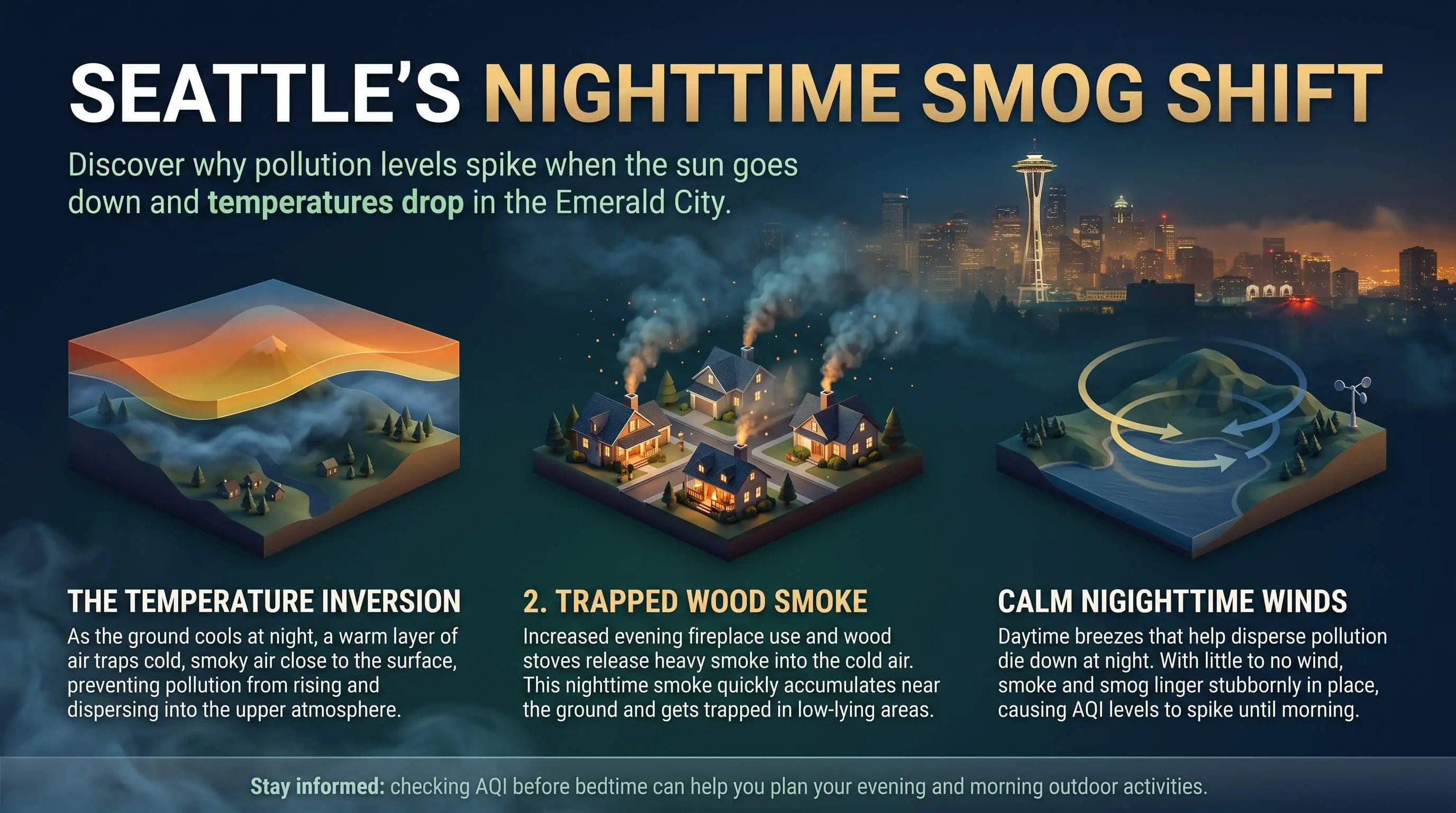
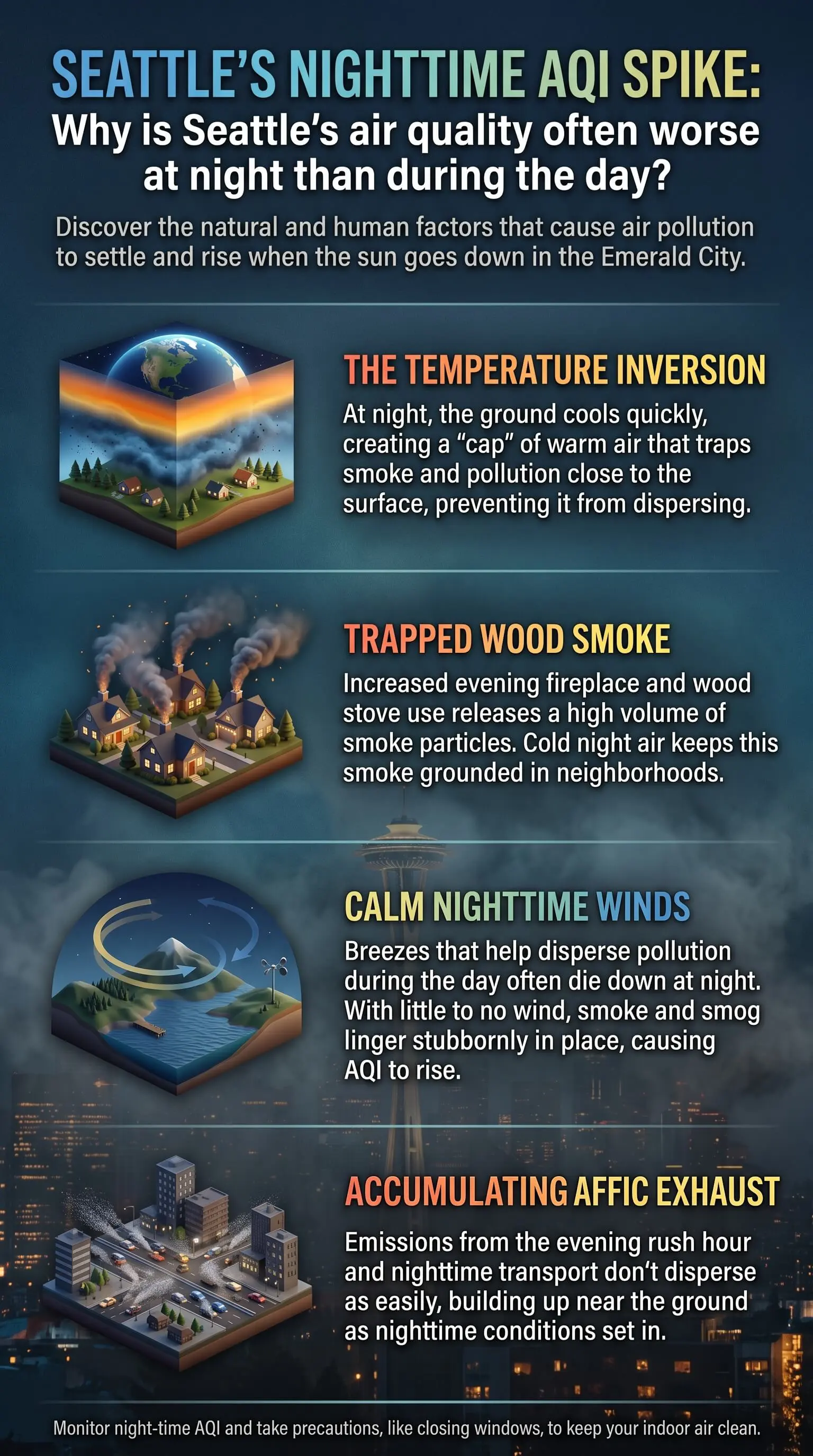
Blame fine particles. Seattle's evening spikes almost always come from PM2.5, not ozone. Ozone needs sunlight to form, so it peaks mid-afternoon and fades once the sun drops. Fine particles skip that step entirely. They pour straight out of tailpipes and chimneys and pile up any time the air stops moving.
During the day, the sun warms the ground and rising air carries pollution up through a deep layer of sky. After sunset, that mixing layer can collapse to a few hundred feet. The same smoke and exhaust now crowd into a much smaller space, and the air at street level gets dirtier. This helps explain the AQI meaning behind higher nighttime readings and why air quality can worsen even when pollution levels haven't increased.
How Do Temperature Inversions Trap Pollution Over Puget Sound?
The air usually gets cooler the higher you go. On clear, calm nights, that flips. The ground sheds heat fast and chills the air right above it, while a warmer layer sits on top like a lid on a pot, and pollution can't climb through it. The National Weather Service says these inversions usually set up in the evening and hang on until the morning sun warms the surface.
Puget Sound's geography tightens that lid. With the Olympics to the west and the Cascades to the east, cold air pools in the lowlands between them, and low-lying neighborhoods feel it first. Fall and winter bring the longest nights and the strongest inversions, and a stubborn high-pressure ridge can repeat the pattern for days until rain and wind clear things out. This trapped air explains why dust and other airborne particles linger near the ground, although what causes dust in the first place depends on local sources.
Why Does Wood Smoke Push the Numbers Up After Dinner?
Evening is when the fireplace gets lit. The Puget Sound Clean Air Agency names fine particle pollution from wood smoke as one of the most serious air quality problems in the region, with levels that usually peak in the colder fall and winter months.
On a still night, that smoke barely moves. It sinks back into the same few blocks it came from, which is why one busy chimney can push a neighborhood sensor higher than a freeway a mile away. When the forecast calls for stagnant air, the agency can issue a Stage 1 or Stage 2 burn ban that limits wood burning until conditions improve. Wildfire smoke and Fourth of July fireworks follow the same rules. Anything that drifts in under an evening inversion stays trapped near the ground until morning.
Why Does My AQI App Jump Late at Night?
The air quality index for particles rests on a 24-hour average, and nobody wants to wait a full day to learn the air has turned. So the EPA uses a formula called the NowCast, which gives the latest hours more weight when pollution changes fast. As particles build after sunset, the NowCast climbs quickly. Apps that pull hourly or low-cost sensor data can climb faster still.
Location plays a part too. A sensor on a quiet street lined with wood stoves can run noticeably higher than the official monitor a few miles away. Both can be right, since each reads the air around its own spot.
What Do Nighttime Spikes Mean for the Air Inside Your Home?
You spend those hours asleep, breathing the same air for seven or eight hours. Closed doors slow outdoor particles down, but plenty still sneak in around window frames and through bath fans. The good news is that a few small habits make a big difference on inversion nights.
Close the windows before bed when the evening AQI is rising, even if the air feels crisp.
Switch the thermostat fan from "Auto" to "On" overnight so air keeps moving through your HVAC filter between heating cycles.
Use a snug, pleated filter, and step up to MERV 13 if your system can handle the airflow.
Skip the fireplace on burn ban nights, and save candles and high-heat cooking for earlier in the day.
Put a portable HEPA purifier in the bedroom of anyone at home with asthma or a heart or lung condition.
"In my experience, the reading that matters most in a Puget Sound winter is the one you see after dinner. Once an inversion settles in, wood smoke builds right at the roofline, and a closed-up house with the furnace fan on 'Auto' keeps drawing that air in through every gap while the filter sits idle between heating cycles."
7 Essential Resources
1. How Nighttime Inversions Form
The National Weather Service explains in plain terms why long, clear, windless nights trap cold air and pollution close to the ground.
Source: National Weather Service: What Is a Temperature Inversion?
2. Wood Smoke Rules for Puget Sound Homes
The Puget Sound Clean Air Agency shows how to burn cleaner and where to check burn ban status before you strike a match.
Source: Puget Sound Clean Air Agency: Wood Smoke Guide
3. Statewide Monitoring and Smoke Forecasts
Washington's Department of Ecology runs the state's monitoring network. Its smoke page pairs forecasts with an AQI color guide, which helps when your app and the news disagree.
Source: Washington State Department of Ecology: Wildfire Smoke
4. Health Guidance for Every Kind of Smoke
The state Department of Health covers wood stove smoke and wildfire smoke, with steps to protect kids, older adults, and anyone with a lung or heart condition.
Source: Washington State Department of Health: Smoke From Fires
5. King County's Indoor Air Playbook
Public Health Seattle and King County shows how to check conditions and clean the air inside, and it explains which masks actually help.
Source: King County: Wildfire Smoke
6. Seattle's Own Smoke Preparedness Checklist
Seattle's checklist covers what to do before smoke rolls in, including signing up for local alerts.
Source: City of Seattle: Prepare Now for Wildfire Smoke
7. What Fine Particles Do Inside the Body
The NIEHS fact sheet sums up current research linking PM2.5 to heart, lung, and brain health, along with its effects on children.
Source: NIEHS: Air Pollution and Your Health
3 Statistics
More Than Half of Winter Fine Particles Near Seattle Came From Wood Smoke
An EPA-funded assessment of the Tacoma-Pierce County area, about 20 miles south of Seattle, traced 53 percent of fall and winter fine particle pollution at the Tacoma South L Street monitor to wood smoke. Vehicles added 25 percent, and levels peaked overnight and early in the morning.
Source: U.S. EPA: Puget Sound Residential Wood Smoke Reduction Assessment
Roughly Half of an Outdoor Smoke Spike Can Show Up Indoors
Lawrence Berkeley National Laboratory's research review found that during smoke events, indoor particle levels in measured homes rose by 49 to 76 percent of the outdoor increase, depending on particle size.
Source: Lawrence Berkeley National Laboratory: Wildfires and Indoor Air
Seattle-Tacoma Ranks 8th Worst for Short-Term Particle Pollution
The American Lung Association's 2026 State of the Air report, built on 2022 to 2024 data, gave the Seattle-Tacoma metro an F and ranked it 8th worst in the country for short-term particle pollution.
Source: American Lung Association: 2026 State of the Air, Washington
Final Thoughts and Opinion
I'd argue most of us check the AQI at the wrong time of day. Morning coffee shows green, and we assume the day stays that way. In the Puget Sound lowlands, especially from October through February, the after-dinner number tells you far more.
Most of this sits in your hands. Nobody can move an inversion, but you can leave the fireplace dark on a still night, keep the windows shut, and let your HVAC fan push air through a good filter while everyone sleeps. Those quiet choices protect your greatest assets, your family, your home, and your HVAC system, in the room where you spend a third of every day.
Frequently Asked Questions
What Time of Day Is Seattle's AQI Usually Worst?
Outside wildfire season, Seattle's fine particle readings tend to peak late in the evening and into the early morning, especially on clear, calm nights in fall and winter. Inversions hold evening wood smoke and exhaust near the ground.
Does Rain Improve Seattle's Air Quality?
Usually, yes. Pacific storms bring rain and wind that break up inversions and wash fine particles out of the air. Seattle's worst winter air tends to show up during dry, sunny, high-pressure stretches instead.
Is It Safe to Open Windows at Night When the AQI Is Moderate?
Most healthy adults won't feel a Moderate reading. People with asthma, heart disease, or a lung condition often do. When the evening AQI is climbing, keep the windows shut overnight and let your HVAC filter handle the air.
Why Is Seattle's AQI Higher in Winter Than Summer Outside Wildfire Season?
Winter stacks the deck. Long nights, frequent inversions, and home wood heating keep fine particles close to the ground for hours at a stretch. Summer brings deeper daytime mixing and far less wood burning.
See How Tonight's Seattle AQI Compares With This Afternoon's
Pull up tonight's Seattle AQI and set it beside this afternoon's reading, and you'll see the inversion pattern for yourself. Whenever the number climbs on a clear, still evening, close the windows and switch your fan to "On" so your filter can protect the air your family sleeps in. Proper roofing can further protect your home by sealing gaps that allow outdoor air and pollutants to enter.